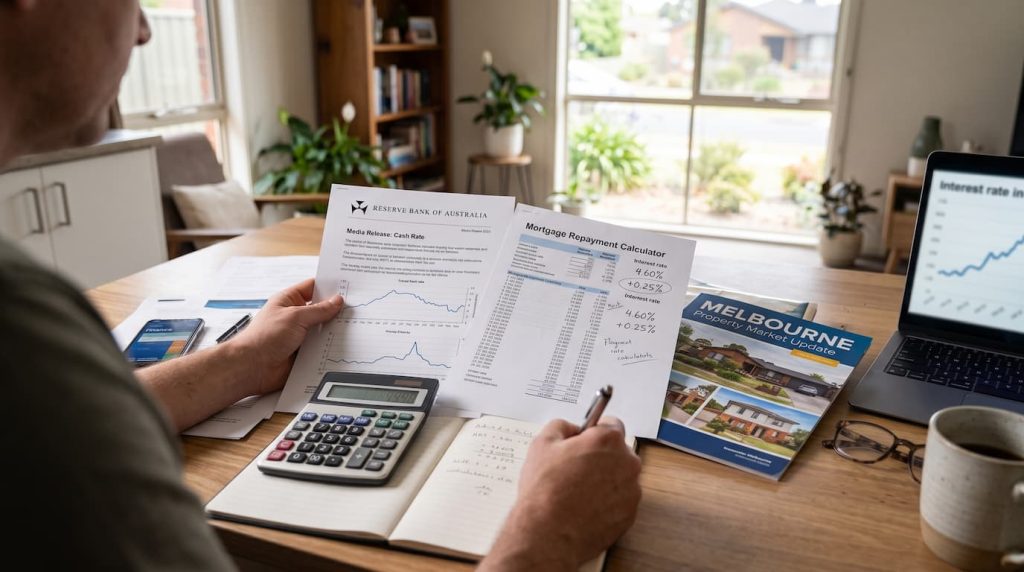

Falling property prices across Melbourne’s west may look concerning, but some investors see the downturn differently. Lower entry prices, continued population growth and major infrastructure investment are creating a counter-cyclical opportunity for buyers willing to look beyond short-term market weakness.
For investors considering Melbourne’s western suburbs, understanding borrowing capacity and available investment home loans can help determine whether current prices fit a longer-term property strategy.
Key Takeaways
- Melbourne’s western suburbs have experienced some of the city’s more pronounced property price falls.
- Recent tax changes, higher interest rates and weaker investor activity have contributed to softer prices.
- Many properties in Melbourne’s west remain within price ranges traditionally attractive to investors.
- Infrastructure investment and population growth continue despite the current property downturn.
- Inner-west and outer growth-corridor suburbs offer different investment characteristics.
Why Are Property Prices Falling in Melbourne's West?
The decline across Melbourne’s west is occurring alongside a broader pull-back in property investment.
According to the client content, changes to negative gearing, Capital Gains Tax and Victoria’s land tax settings have contributed to weaker investor activity. New home investor loans in Victoria subsequently fell by 12.5 per cent, while more established properties entered the market as buyer demand cooled.
Median Melbourne house prices fell by approximately 3.1 per cent in a single quarter, with some of the more noticeable and affordable declines occurring in the city’s outer-western suburbs.
For existing investors reviewing their lending as conditions change, investment property refinancing may also be worth discussing where appropriate for the type of property held.
Why Could Falling Prices Create an Opportunity?
Property downturns can create an unusual situation. The same falling prices that make some buyers hesitant can reduce the cost of entering the market for others.
Ray White Chief Economist Nerida Conisbee told realestate.com.au:
“Investors tend to be more active in areas where the median in sub-$850,000 and when you have a look at Melbourne’s west, there are a lot of properties at that price point.”
She also described current conditions as a buyer’s market, while noting that buyers often become nervous when prices are falling and return only once values begin recovering.
That hesitation can potentially give prepared investors greater negotiating power and access to properties at lower purchase prices.
Can a Lower Purchase Price Improve Long-Term Returns?
Buying at a lower price can reduce the amount an investor needs to borrow and potentially improve the economics of an investment.
The client article takes a counter-cyclical approach, arguing that investors can use periods of weaker sentiment to enter the market at prices below previous peaks.
There is, of course, no guarantee that prices will recover within a particular timeframe. Investors still need to consider rental income, borrowing costs, holding expenses and their capacity to withstand further market movements.
The key point is that today’s purchase price matters. Paying less for an otherwise suitable asset can provide more room for future capital growth if market conditions improve.
Is Melbourne's West Still Growing?
The current property downturn does not mean Melbourne’s western corridor has stopped developing.
Significant state and federal investment continues across the region, with the client highlighting projects and precinct development associated with the West Gate Tunnel, transport connections, healthcare and retail infrastructure.
These improvements can matter to property investors because transport, employment, healthcare and local amenities influence how attractive an area becomes to future residents.
The benefits are generally long term rather than immediate. Infrastructure spending alone does not guarantee property growth, but it can strengthen the fundamentals of an area as its population expands.
How Could Population Growth Support Melbourne's Western Suburbs?
Affordability continues to make the west an important destination for Melbourne’s expanding population.
Wyndham, Melton and Brimbank are highlighted in the client content as areas continuing to attract families, migrants and younger professionals seeking more affordable housing.
That matters because long-term housing performance ultimately depends heavily on the relationship between supply and demand.
Currently, housing supply may be exceeding buyer demand in parts of the west. Continued population growth, however, could progressively absorb some of that available housing and support both owner-occupier and rental demand over time.
Which Melbourne Western Suburbs Could Investors Consider?
Not every part of Melbourne’s west offers the same investment proposition.
What Do Inner-West Suburbs Offer Investors?
The client identifies Footscray, Yarraville and Sunshine for investors interested in established areas with historical growth, gentrification and rental demand from young professionals.
These suburbs provide greater proximity to central Melbourne and more established infrastructure, although their purchase prices may differ substantially from those further west.
What Do Outer-West Growth Corridors Offer?
For investors prioritising affordability and population growth, the article highlights Point Cook, Truganina and Tarneit.
These areas may provide access to newer, relatively low-maintenance family homes while benefiting from continued population inflows across Melbourne’s growth corridors.
The right choice ultimately depends on whether an investor is prioritising entry price, rental demand, potential capital growth or the ongoing cost of owning the property.
Is Now a Good Time to Invest in Melbourne's West?
There is no single answer that applies to every investor.
Melbourne’s west currently combines softer property prices with substantial long-term population and infrastructure growth. That combination can make the region worth investigating, particularly for investors who have the borrowing capacity and financial flexibility to hold property through weaker market conditions.
The important distinction is between buying simply because a property has become cheaper and buying a quality asset at a better price.
Explore Property Investment Finance With Perry Finance
Periods of market uncertainty can create opportunities, but financing, cash flow and borrowing capacity remain just as important as choosing the right suburb.
If you’re considering an investment property in Melbourne’s west, learn more about Perry Finance or contact Perry Finance to discuss your property finance options.